Showing posts with label indian history. Show all posts

Wednesday, 22 September 2010

The British in India - Consolidation & Polarisation


After the departure of Hastings in 1785, his two most important successors as Governor-General were Lord Cornwallis and Lord Wellesley. The first was a conservative reformer who was keen to bring restraint to the administration of India, the second was a military expansionist whose defeat of the French consolidated the region as the Jewel in the Crown of the newly expanded British Empire.

For Cornwallis, the British had to show their superiority to the local population by example and his paternalistic attitude combined rule of law with the exclusion from government posts of all Indians. His recognition that a British dominated system of government should serve the Indian public was still motivated by British interest. Relieved that rains had averted a famine, he wrote that 'there is now I trust no danger of losing the inhabitants, or of much failure in the revenue'. He improved gaols, reformed the coinage, suppressed child slavery, limited patronage amongst the whites and insisted on large salaries for their posts so that plunder could be discouraged. After the war against Tipu Sultan he stunned his own officers by leaving the ruler of Mysore on his throne. Of course this was a political move which blocked Tipu's rivals whilst forcing the ruler to concede large territorial amd financial claims to the British.

For Wellesley, elder brother of the Duke of Wellington, the conflicts in India with both Tipu Sultan and the French allowed the British to dominate the region completely. Wellesley conquered more territory in India than Napoleon did in Europe. Tipu Sultan had promised a holy war of vengeance since his defeat by Cornwallis and this led to his demonisation by the British as a savage monster. Certainly the ruler of Mysore had a reputation for cruelty, but moral attacks from the masters of the slave trade were nothing but hypocrisy. The ruler of Mysore was celebrated by his own subjects as cultured and fair, while he possessed a superb French-trained army and a magnificent palace. This then was the prize for the British forces when they won the battle of Seringapatam. Piers Brendon notes that 'Loot was a Hindi word but the British soon adopted it,' and the Tiger of Mysore's palace was duly ransacked. Wellesley wanted to 'heap kingdoms upon kingdoms, victory upon victory, revenue upon revenue' and with the help of his brother, he extended British dominance after the defeat the Maratha Confederacy. An extravagant Governor-General, Wellesley constructed a new neo-classical Government House which cost £170,000. His rude and dominant attitude towards the local white community which saw him encase himself in ceremonial majesty was, in itself, a reflection of the feelings now held by the whites towards the Indians.

Native culture was now seen as inferior by a white community that had institutionalised discrimination throughout their administration. The success that the British had won in India had also created a greater insecurity that they might lose it all, so they endeavoured to shore up their new power by establishing themselves as the superior caste. Throughout the region there was a clear polarisation in Indian society that could be seen in the stark contrast between the opulent White part of Calcutta and the festering conditions of its 'Black Town.'

Wednesday, 15 September 2010

The East India Company - Conquest & Plunder


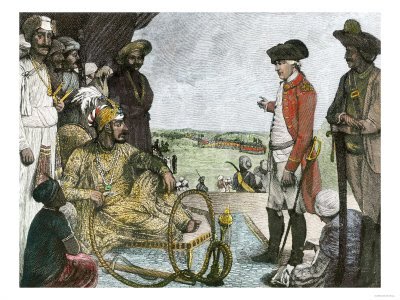
Unlike the American and West Indies Colonies, the British expansion in India was down to force of arms rather than through the settlement of white colonisers. India was taken into the British Empire gradually over decades as increasingly valuable trading posts became protected by ever-greater numbers of soldiers. As the riches of the subcontinent were exploited more and more, military alliances were formed with local rulers and divisions amongst the Mughals and their rivals were exploited to the East India Company's advantage. Lord Bryce described the emerging British Raj as having 'a permanently military character' and by the 1770s the East India Company had over 100,000 men under arms. Yet the constant strand throughout the period was the fear amongst the comparatively tiny white garrison that what had been won by force could be lost by force.

Originally Queen Elizabeth had given the East India Company its charter in 1600 and it would grow to become the main power in India within the next 200 years. Gradually overtaking competitors like the Dutch East Indian Company, they established their outposts on the fringes of the Mughal Empire in order to trade in spices. The 17th Century was a golden age for Mughal culture and the Mughals had more opulent cities than Europe. However the standard of Mughal Emperor declined in the 18th Century as power struggles erupted and, as Macaulay described, successive incumbents 'sauntered away life in secluded palaces, chewing bang (cannabis), fondling concubines, and listening to buffoons.' Internal revolts combined with Persian and Afghan invasions meant that the disordered land was ripe for the British and the French to exploit. In making alliances with local rulers, the East India Company could gain control of further commerce which paid for more sepoys (native soldiers) to conquer further territory, which in turn gave more tax revenue and yet more commercial gains. With a superior navy and better military leadership the British outdid the French easily and by 1761 had crushed their allies and controlled Bengal.

Yet the East India Company was only interested in commercial gain and not in administration. This meant that the province of Bengal was plundered by the tyrannical Company men who were to build vast palaces and extract valuable gifts, before returning home to scandalise society with their ill-gotten gains. Piers Brendon supposes that they may have been 'rendered callous by their own likely fate: about 60 per cent of the Company's appointees died before they could get back to England'. However, vast fortunes were made for the surviving Company employees whilst the province collapsed into famine and death. Between 1773 and 1774 around 5 million people starved to death: one third of Bengal's population. Less people meant less tax revenue and the East India Company's share price began to fall. In 1784 the India Act saw the government take control away from the Company; in 1788 Governor-General Hastings himself was impeached by the House of Lords under charges of misgovernment and corruption.

Although Hastings had been relatively respectful of Indian culture and had seized less riches personally than previous Governor-Generals, the perpetual warfare of his regime was not only costly to Britain; his self-made nabobs that had corrupted the elites of India were now seen as spreading their immorality to British society with many buying rotten borough parliamentary seats. This meant that his never-ending trial would see the British debating the very nature of their new Empire with the great debater Burke accusing Hastings of being 'a ravenous vulture devouring the carcases of the dead.' However, key witnesses were to contract amnesia when it came to providing evidence of Hastings personal culpability in corruption and he was acquitted in 1795. By then, any collective guilt surrounding imperial adventure had been overtaken by a new centralised zeal that insisted that Indians were uncivilized, their culture backward and that India must be 'ruled by an absolute power.'

Source:

Piers Brendon, The Decline and Fall of the British Empire, 1781 - 1997.